A seating team has a medial thigh support in hand and needs to know where it mounts, which way it moves, and what it does to a transfer. The answers differ between named products, so the mount and the fit have to be checked together rather than assumed from the pad alone.
A wheelchair medial thigh support is a pad and bracket that sits between the thighs, usually on a seat-frame or seat-rail mount, to give a medial contact point. Its shape, interface, and swing-away hardware vary by product, so compare the named design and confirm the individual fit with the seating team.
Wheelchair medial thigh support: Identify medial thigh support and related terms
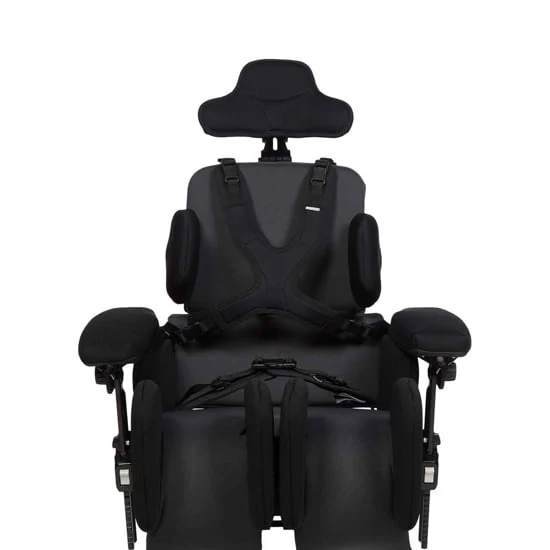
The first task is naming. A medial thigh support is described by its position: medial means toward the midline, so the pad sits between the thighs rather than on the outside of either thigh. That single fact separates it from lateral thigh supports and lateral trunk supports, which contact the outer surfaces. It also separates it from a hip guide, even though the two are often discussed in the same conversation about pelvic and thigh positioning.
Related terms appear in product listings and in seating notes, and they are not fully interchangeable. A wheelchair medial thigh pad usually refers to the cushion or pad element itself. A wheelchair medial knee support describes a pad placed lower, near the knee rather than along the thigh, and the contact point changes what the hardware has to reach. A wheelchair abductor support is a broader label: abduction means movement away from the midline, and an abductor pad is placed to resist that movement, which in practice often means a medial position between the knees or thighs. The label describes intent, not a universal shape.
This matters because a search result, an order form, and a fit note may use three different names for similar-looking parts. Before comparing anything, write down the exact product name, the manufacturer, and the position the pad is meant to contact. If a listing calls an item both a medial thigh support and a hip guide, treat that as a product-specific naming choice rather than proof that the two categories are the same. The distinction is useful in its own right: a hip guide is generally discussed in relation to the pelvis and upper thigh, while a medial thigh support is discussed in relation to the inner thigh surface and the space between the legs.
Terminology also affects what you ask for later. A spare-part request or a replacement pad question needs the exact product name and the mounting interface, not just the word medial. The same applies when a team is comparing a medial pad with a lateral hip guide: they may sit near each other on the chair, but they contact different surfaces and are mounted and adjusted differently. Getting the name right at the start prevents a comparison between two parts that were never meant to do the same job.
A further source of confusion is the word support itself. In seating vocabulary it can describe a contact surface, a positioning aid, or a structural bracket, and a single product may combine all three. When a note says the chair has a medial support, ask which element is meant: the pad, the arm that holds it, or the whole assembly. That question is not pedantic, because each element has its own replacement path and its own compatibility question. A pad may be listed separately from the bracket that carries it, and a bracket may be tied to a particular seat frame rather than to a pad size. Recording the assembly as three named parts, pad, arm, and mount, gives the team a clearer picture than a single label and makes later ordering or repair conversations more precise.
Compare the named pads and their mounting

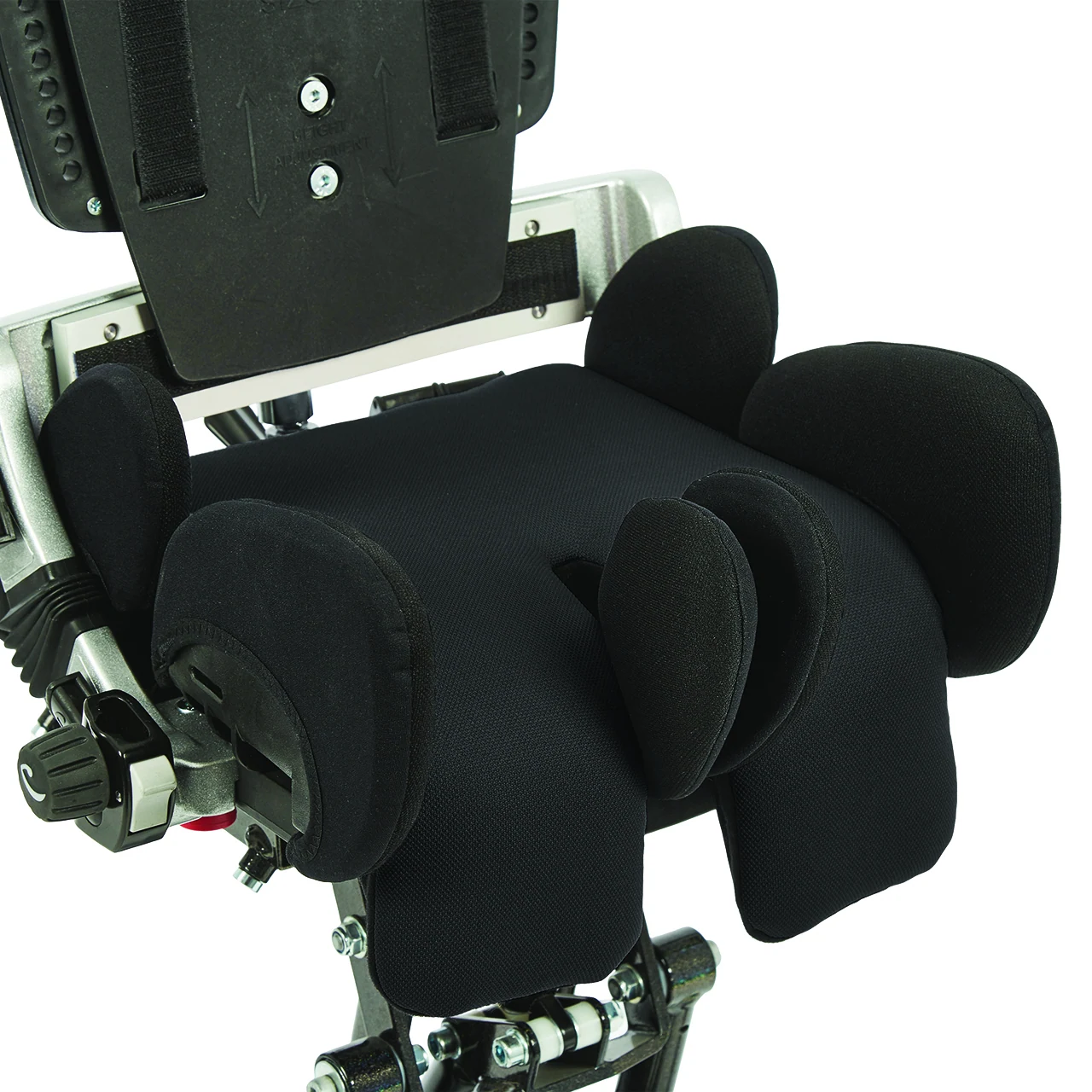
The supplied product pages for the Spex Standard Medial Thigh Support and the Freedom Designs medial thigh supports give a workable comparison because both are named, product-specific sources rather than generic descriptions. Read them as two design records, not as a ranking. The useful questions are what the pad looks like, how it attaches, and what hardware allows it to move.
| Comparison point | What to record | Why it changes the decision |
|---|---|---|
| Exact product name and manufacturer | Spex Standard Medial Thigh Support; Freedom Designs medial thigh supports | Confirms you are comparing named items, not categories |
| Pad shape and contact surface | Shape and size as stated on the product page | Shape affects where contact falls along the thigh |
| Mounting interface | The bracket, rail, or frame connection the page describes | Determines whether it suits the chair’s seat frame |
| Swing-away or flip hardware | Whether the design includes hardware that moves the pad aside | Affects transfer clearance and stowing |
| Adjustment range | What the page states about positioning or adjustment | Shows how much fitting latitude the design offers |
| Items to confirm with the supplier | Anything the page does not state | Prevents assumptions about fit or compatibility |
Use the table as a recording sheet rather than a verdict. If one page describes a pad shape and a mounting approach in detail and the other describes a different arrangement, that difference is the finding. It tells the seating team which design to examine against a specific chair and a specific user, and it tells the user what to look at when the pad is presented during a fitting appointment.
Mounting deserves particular care because it links the pad to the chair, not to the person. A bracket that suits one seat frame may not suit another, and the product page is the right place to check what the manufacturer states about the interface. Where a page does not state a dimension, a compatibility claim, or an adjustment range, record it as an open question for the supplier rather than filling the gap by inference. The same discipline applies to pad size: a larger pad is not automatically better, and a smaller pad is not automatically less supportive. What matters is the contact the seating team intends and whether the named product can provide it on that chair.
Comparing two named designs also helps a team avoid a common shortcut: assuming that because two pads are both called medial thigh supports, their hardware is interchangeable. It is not safe to assume that a bracket, clamp, or swing-away mechanism from one product fits another. Keep each product’s mounting details with its own name, and treat cross-fitting as a question for the manufacturers involved.
There is also a practical ordering consequence. If a team decides during fitting that a different pad shape or a different arm length would serve the user better, the replacement has to be matched to the existing mount or the mount has to change with it. Writing down which parts belong together, and which were supplied as a set, saves a second fitting appointment later. A comparison table is only useful if it ends in that kind of specific, checkable note rather than a general impression that one design looked tidier.
Check swing-away movement and transfer space

A medial pad sits in the space a person uses when getting in or out of the chair, so its movement is a practical question, not a detail. Some designs include hardware that swings or flips the pad away from the midline; others are fixed in position. The supplied product pages are the place to check which arrangement a named product uses, and the chair and the person’s transfer method are the place to check whether that arrangement works.
Start with the path the pad takes. A swing-away support moves through an arc, and that arc occupies space beside or in front of the seat. If the chair is positioned close to a wall, a bed, a vehicle seat, or a transfer board, the arc may be blocked even though the pad itself is small. A fixed support does not move at all, so the transfer has to work around it. Neither arrangement is universally better; the question is which one matches the way this person actually transfers and the space where the transfer happens.
Then separate three things that are easy to blur together. The first is the chair’s configuration: the seat frame, the mount, and any other seating components near the midline. The second is the person’s requirements and transfer method, which the seating team assesses. The third is the environment: the room, the vehicle, or the clinical space where the transfer takes place. A pad that swings clear in a spacious room may still be awkward in a narrow bathroom, and a fixed pad that suits one transfer style may obstruct another. Recording these three separately keeps a fit note honest about what was actually checked.
It also helps to record the stowed position. When the pad is moved aside, where does it end up, and does it stay there during the transfer? Does it return to the same position afterward, or does it need to be reset? These are observations for the fitting appointment, not specifications to assume from a product name. If the product page does not describe the movement, ask the supplier or the seating team to demonstrate it on the actual chair. For a user preparing for an appointment, a useful question is simply: with this pad in place, can I get in and out the way I usually do, and if not, what changes?
Caregivers and transport readers have a related check. If someone else assists with the transfer, the helper needs room to stand and to reach, and a pad that swings toward the helper’s position changes that space. The same applies when the chair is loaded into a vehicle: a pad left in the midline position may catch on a door frame or a ramp edge, while one that folds aside may need to be secured first. None of these points can be settled from a product name, but each can be written down as a question and answered on the actual chair with the actual people involved.
Prepare a clinician-led fit record

The fit record is what turns a comparison into something another person can act on. It should be prepared with the seating team, because the individual fit decision belongs to a qualified professional working with the user, not to a product page or a general article. The record’s job is to capture what was chosen, why, how it was mounted, and what still needs checking.
A practical record covers the exact product and manufacturer, the pad position along the thigh, the mounting interface used, whether the design swings away and how, the transfer method discussed, and any open questions for the supplier. It should also note who confirmed the fit and when, so a later appointment or a repair request has a reference point. Where a dimension or adjustment is unknown, say so plainly rather than estimating it.
| Record field | Example entry | Status |
|---|---|---|
| Product and manufacturer | Named medial thigh support, manufacturer stated | Confirmed from product page |
| Pad position | Where the pad contacts the thigh | Confirmed at fitting |
| Mounting interface | Bracket or rail used on this chair | Confirm against chair frame |
| Swing-away hardware | Present or fixed, and how it moves | Confirm by demonstration |
| Transfer method discussed | The method the user actually uses | Confirm with user and team |
| Open supplier questions | Missing dimensions or compatibility details | To be answered |
| Fit confirmation | Who confirmed and when | Recorded at appointment |
This record has a second use: it separates what a product page states from what was observed on the chair. That distinction matters when a team reviews a fit later, orders a replacement, or hands the chair to a different service provider. It also keeps the article’s comparison in its proper place. Comparing two named pads is useful preparation; it is not a substitute for the assessment that decides whether a medial contact point is appropriate for a particular person, and it does not establish that any pad will improve posture, pressure, or function.
For a distributor or service team, the same record supports a clearer conversation with the manufacturer. Instead of asking whether a pad is compatible, the team can quote the chair model, the existing mount, the pad name, and the specific question that remains open. That is a more answerable request, and it keeps the responsibility for the fit decision with the people who assessed the user rather than with whoever answers the enquiry.
FAQ

Is a medial thigh support the same as a hip guide?
No. They are related but distinct terms. A medial thigh support is positioned between the thighs, while a hip guide is generally discussed in relation to the pelvis and upper thigh. Some product listings use overlapping language, so check the exact product name and the surface the pad is designed to contact rather than relying on the category label alone.
Who confirms the individual fit?
A qualified seating professional working with the user confirms the individual fit. A product page can describe a pad’s shape and mounting, and a comparison can help a team prepare, but neither establishes that a particular support is appropriate for a particular person. Bring the product details and the open questions to that appointment.
Conclusion

Compare the named pad, its mount, and its swing-away movement, then record the fit with your seating team before deciding.