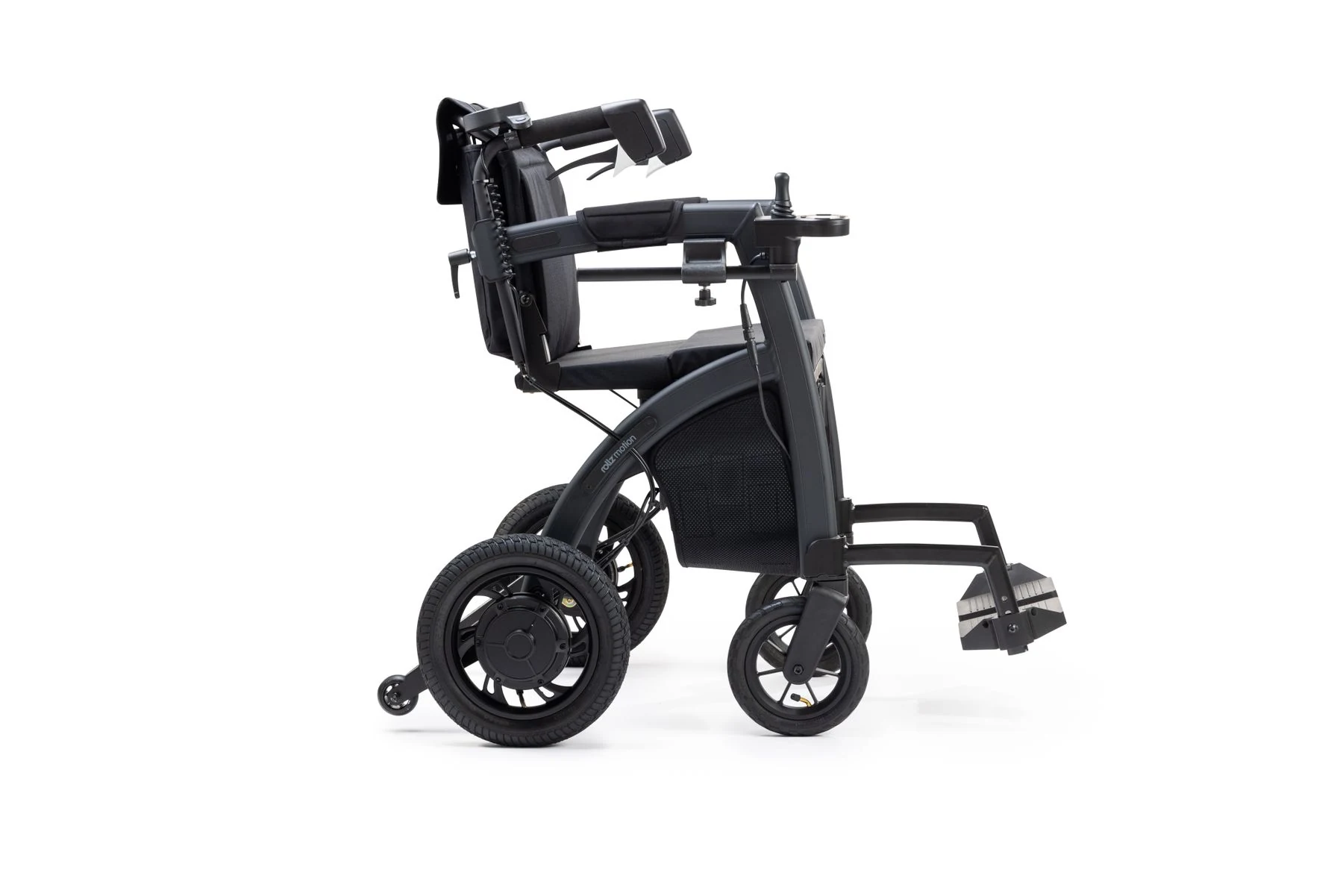
You are comparing an attendant controlled power wheelchair for a family member, a care setting, or a dealer enquiry, and the brochure says "attendant control available." The useful question is narrower than that phrase suggests: who holds drive authority, how is it handed over, and which documents prove the arrangement fits this exact chair.
A power wheelchair attendant control lets a second person drive the chair from a separate input, usually mounted at the rear. It is not a brake, and it is not interchangeable between models. Verify the named controller, the handover method, the mounting position, and the manufacturer's compatibility documentation before you rely on it.
Power wheelchair attendant control: What attendant control means on a power chair
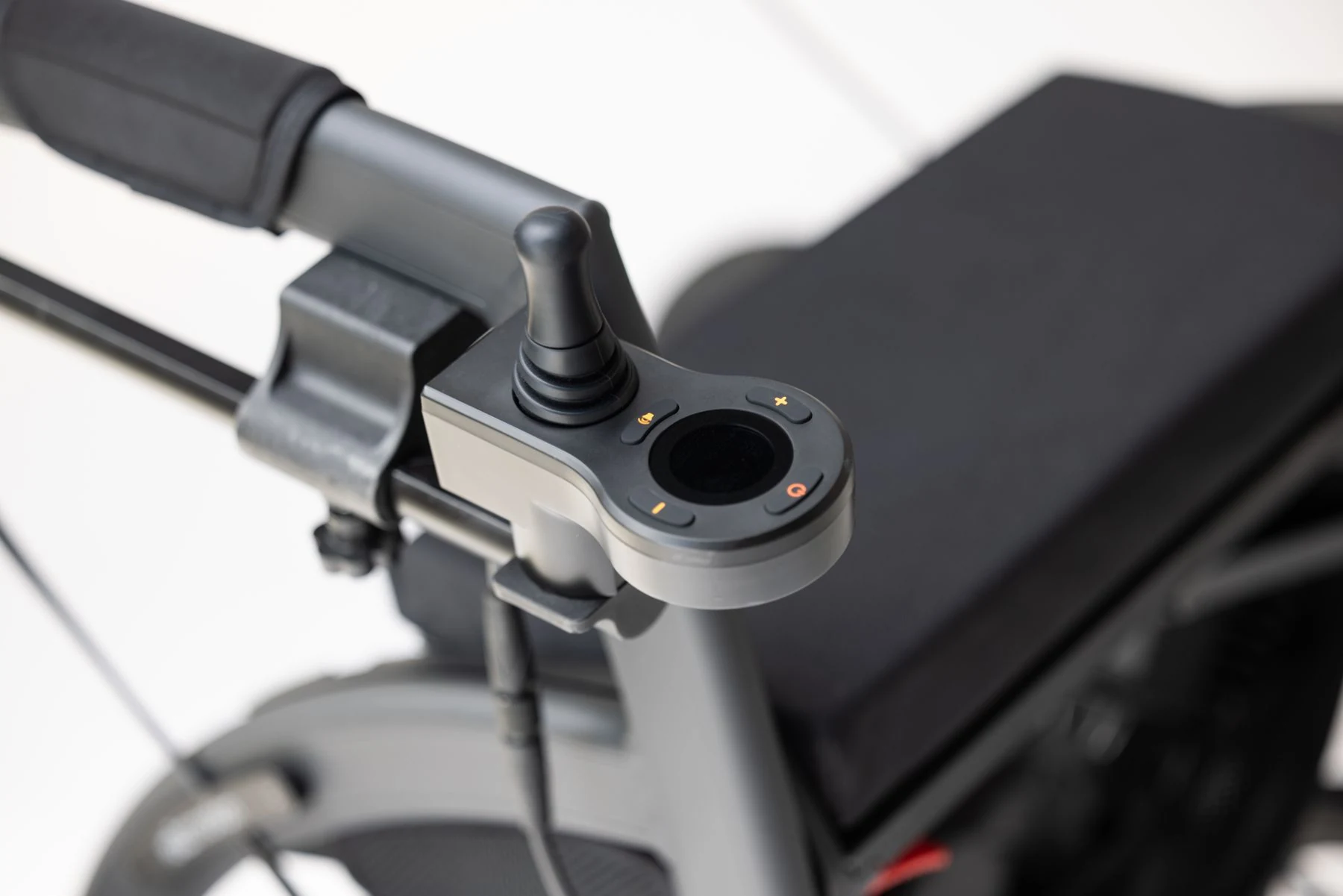
On a power chair, the attendant control is a drive input. The person standing behind the chair uses a joystick or similar unit to command the motors, so the chair moves under their direction rather than the seated user's. That is a fundamentally different function from anything a manual wheelchair attendant handle does. On a manual chair, the attendant pushes and applies a brake; the chair has no motor to command and no electronic control authority to transfer. Nothing about a manual attendant brake tells you how a powered system will behave.
This distinction matters because the two are often described with similar words. A caregiver wheelchair joystick is an electronic interface that has to be wired into, or recognised by, the chair's control system. It depends on the chair's electronics, its programming, and the manufacturer's approval of that combination. A manual brake depends on cable tension and mechanical adjustment. Confusing the two leads buyers to ask the wrong questions — about handle height or grip, for example — when the real questions concern controller family, connector type, software configuration, and who is authorised to change settings.
The supplied manufacturer material illustrates how specific this gets. Invacare's dual control user manual, revision 001, covers a named dual control arrangement and sets out its own operating and handover content; that manual's scope is that product, not power chairs generally. Karma Medical lists an attendant control as a product with its own documentation. Permobil describes a standard attendant control as an accessory within its drive controls range. Marc's Mobility compares several attendant control options from a seller's viewpoint. Each of these is a source about a particular offering. None of them establishes that a control from one maker will work on another maker's chair, and none should be read as a general statement about all attendant controlled power wheelchairs.
For a reader, the practical consequence is that "does it have attendant control?" is the wrong opening question. Better: which control, on which chair, under which manual revision, and what does that manual say about switching between the seated user's input and the attendant's? Those four items can be checked. A generic yes cannot. It also helps to separate the drive question from the seating question: an attendant control changes who commands movement, not whether the seated position, posture support, or pressure management suits the user. Those remain separate matters for the people qualified to assess them, and a control accessory should never be presented as a substitute for that assessment.
A second practical consequence concerns expectations about how the chair will feel in use. Because the attendant is commanding the same motors through the chair's own electronics, the response depends on the chair's programming and on the conditions the manufacturer sets for that mode. A dealer or fleet manager should therefore avoid promising a particular speed, sensitivity, or stopping behaviour from a brochure line alone; those details belong to the named system's documentation and configuration.
Document who has control

Control authority is the core safety question, and it should be answered on paper before it is answered in a corridor. For each named system, record how the chair indicates which input is active, what conditions must be met before control passes, and what happens if both inputs are touched at once. Do not carry an answer from one model to another. The Invacare dual control manual is written for its own product; its handover description is evidence about that arrangement only, and a different chair may use a different method entirely.
Build a simple record for the chair you are actually considering. The table below is a structure for that record, not a set of universal answers. Where a cell cannot be filled from the manufacturer's documentation, treat it as an open question to put to the supplier or the chair's service provider.
| Item to record | Why it matters | Where the answer should come from |
|---|---|---|
| Exact chair model and controller family | Compatibility is model-specific | Chair and controller documentation |
| Attendant control product name and manual revision | Different revisions can differ | The manual supplied with the control |
| How the active input is indicated | Users and attendants need a shared signal | Named manual's operating section |
| Conditions for handing control over | Prevents ambiguous authority | Named manual's handover content |
| Behaviour if both inputs are used | Affects how the pair coordinate | Manufacturer confirmation |
| Mounting position and bracket part | Affects reach and stowage | Fitting documentation |
| Who may change settings | Programming is not a user task | Manufacturer or authorised service |
A completed record has a second use beyond the purchase decision. When a chair moves between a household, a clinic, and a care home, or when a controller is replaced during service, the record shows what was originally approved and what has since changed. Without it, a later reader has only a working chair and no way to tell whether the present arrangement matches the documentation. For a dealer handling several chairs of the same model, keeping one record per chair rather than one per model avoids exactly that confusion.
Control handover indication
Handover is where most everyday confusion sits. If the seated user and the attendant cannot both tell, at a glance, which input is live, then the arrangement depends on memory and assumption. Read the named manual's description of the indication — a display state, an enabled/disabled condition, an audible or visible signal — and write down exactly what it says. Then check that the description matches the unit in front of you. If the manual describes an indicator the chair does not have, stop and ask why before proceeding.
It also helps to agree a spoken routine alongside the technical one. The manual tells you what the system does; it does not tell you how two people will coordinate in a doorway. That agreement is a local decision, and it belongs in the handover notes for a care setting or rental fleet. Write it in plain language that a new staff member could follow on their first shift, and review it whenever the people involved change.
Model-specific control interface
The interface is the physical and electronic join between the attendant unit and the chair. Connector type, cabling route, mounting bracket, and any programming step are all model-specific. A dealer comparing options should ask for the interface documentation for the exact pairing, not a photograph of a similar installation. A user or caregiver should ask who is permitted to fit it, because fitting and configuration are service tasks, not household adjustments.
Check the chair, controller and brackets
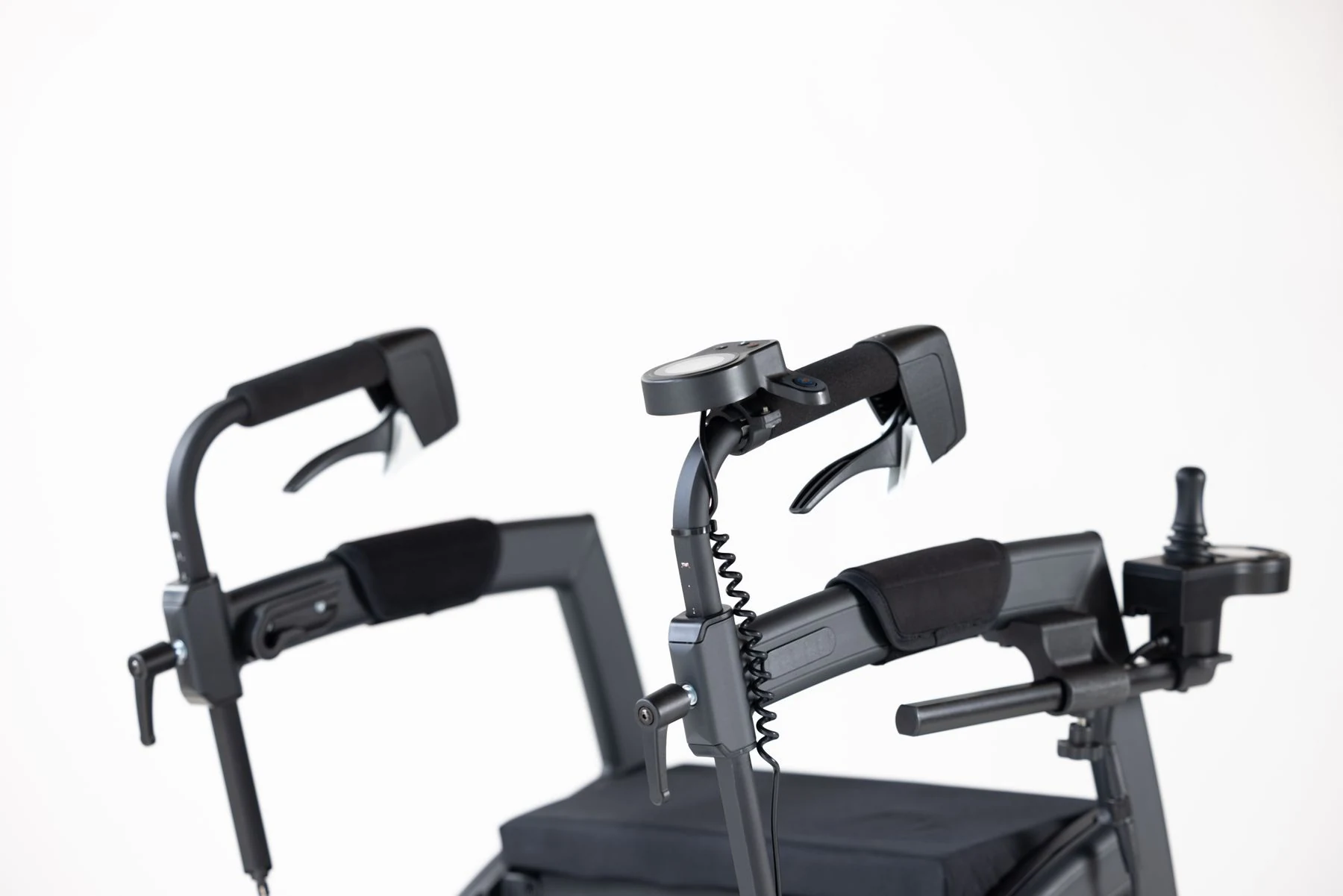
Once you know which control is proposed, verify three things against each other: the chair's electronic system, the mounting position, and the manufacturer's compatibility statement. These are separate checks and one does not imply the others. A bracket that physically fits says nothing about whether the controller is supported. A controller that is supported for the chair may still need a specific mounting position to be reachable and stowable by the attendant who will actually use it.
Start with the electronic system. Identify the chair's controller family from its own documentation and confirm that the attendant control is listed as compatible with it. If the only evidence is a seller's description, treat it as a lead rather than a confirmation. Marc's Mobility's comparison is useful for seeing what kinds of options exist and what a seller emphasises, but it is a seller's view; it does not certify compatibility for your chair.
Next, the mounting. Ask where the unit sits, how it is secured, whether it can be stowed when not in use, and whether the position interferes with anything else at the rear of the chair. Reach matters: an attendant of different height, or someone using the chair with a bag or oxygen holder at the back, may find a position workable or awkward. That is a fit question for the actual people involved, and it is best answered with the chair present rather than from a specification sheet. If two attendants share the role, check the position with both of them rather than with the taller or more confident one alone.
Then the paperwork. Keep the compatibility statement, the fitting instructions, and the manual revision together with the chair's records. For an institutional fleet, this is the difference between a documented configuration and an undocumented one; when the chair later changes hands, or a part is replaced, the record shows what was approved. Our overview of electric wheelchair spare parts sets out the kind of part-identification and documentation questions distributors tend to raise, and the same discipline applies here. A general reference on the parts of a wheelchair can help a new caregiver learn the vocabulary, though it does not replace the named control manual.
Finally, be clear about what you are not doing. Verifying a configuration is not the same as installing it. Wiring, connector work, and controller programming belong with the manufacturer's authorised service arrangements, and a buyer should confirm in writing who will carry that out before purchase. If a seller offers to fit a control that the chair's own documentation does not list, that is a question to put back to the manufacturer rather than a detail to settle at the counter.
Plan training and support

A documented configuration still needs people who know how to use it. Training here means three distinct things, and they should be assigned separately rather than lumped into "handover training." The first is individual assessment: whether this arrangement suits this user, given their seating, their usual environments, and how they want to move around. That is a question for a qualified professional who knows the person, not something a brochure or a product comparison can settle. The second is operational training for the attendant and the user together — the handover routine, the indication, and what to do in a doorway, a lift, or a crowded space. The third is exception handling: what to do if the attendant unit does not respond, if the indication is unclear, or if the chair behaves unexpectedly.
Exception handling deserves a written answer rather than an improvised one. Ask the supplier or service provider what the manufacturer's guidance says about a fault in the attendant control, and record the answer with the chair. Do not assume that a documented procedure for one system applies to another, and do not attempt electrical diagnosis or repair unless you are the person authorised to do it. A useful test of the written answer is whether someone who has never seen the chair could follow it: if it only makes sense to the person who wrote it, it is not yet a procedure.
Assign service responsibility explicitly. For a single household, that may be one named service provider. For a care home or a rental fleet, it should be a role, not a person, so the responsibility survives staff changes. Include who checks the mounting and cabling, who holds the manual revision, and who authorises any change to the configuration. A short responsibilities table, kept with the chair's file, prevents the common situation where everyone assumes someone else has checked.
If the chair is being considered for a setting where the seated user will sometimes drive and sometimes be driven, also plan how the two modes are communicated to other staff. A colleague who does not know the chair is in attendant mode may step in front of it. That is an operational briefing issue, and it is cheaper to solve with a routine than with an incident. The same briefing helps visitors and contractors who share a corridor with the chair but have no role in operating it.
FAQ
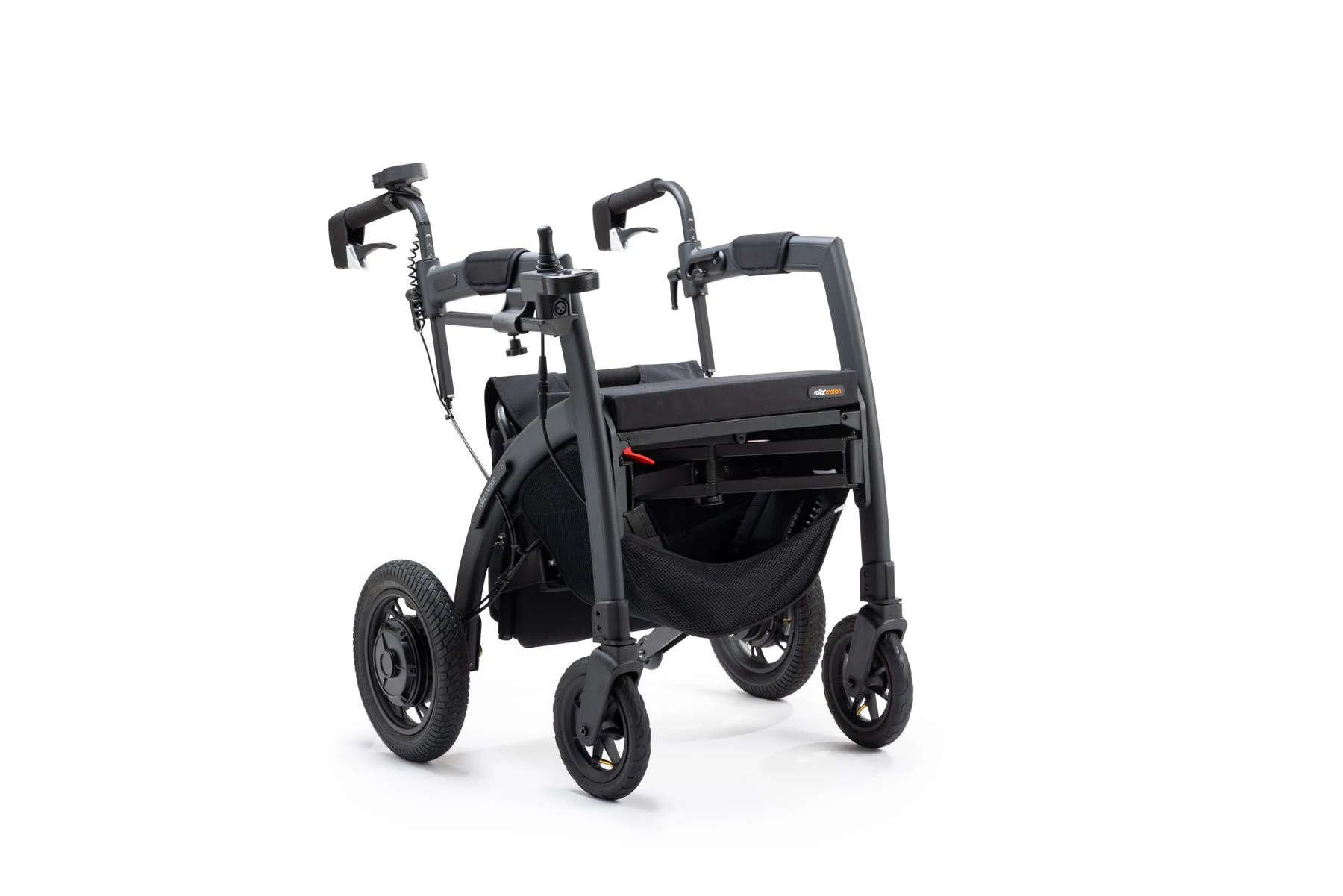
Is an attendant brake the same as power attendant control? No. A manual wheelchair's attendant brake acts on a chair the attendant pushes. A power attendant control commands the chair's motors through its electronic system. They involve different parts, different skills, and different documentation.
Can any attendant controller be fitted? No. Compatibility is specific to the chair's controller family, the mounting arrangement, and the manufacturer's documentation. Ask for the compatibility statement for the exact pairing rather than relying on a general claim that a control is "universal."
How is control handed over? It depends on the named system. Read the manual for that product and record how the active input is indicated and what conditions apply before control passes. Then agree a spoken routine between the user and the attendant, and check that the indication matches the unit in front of you.
Conclusion
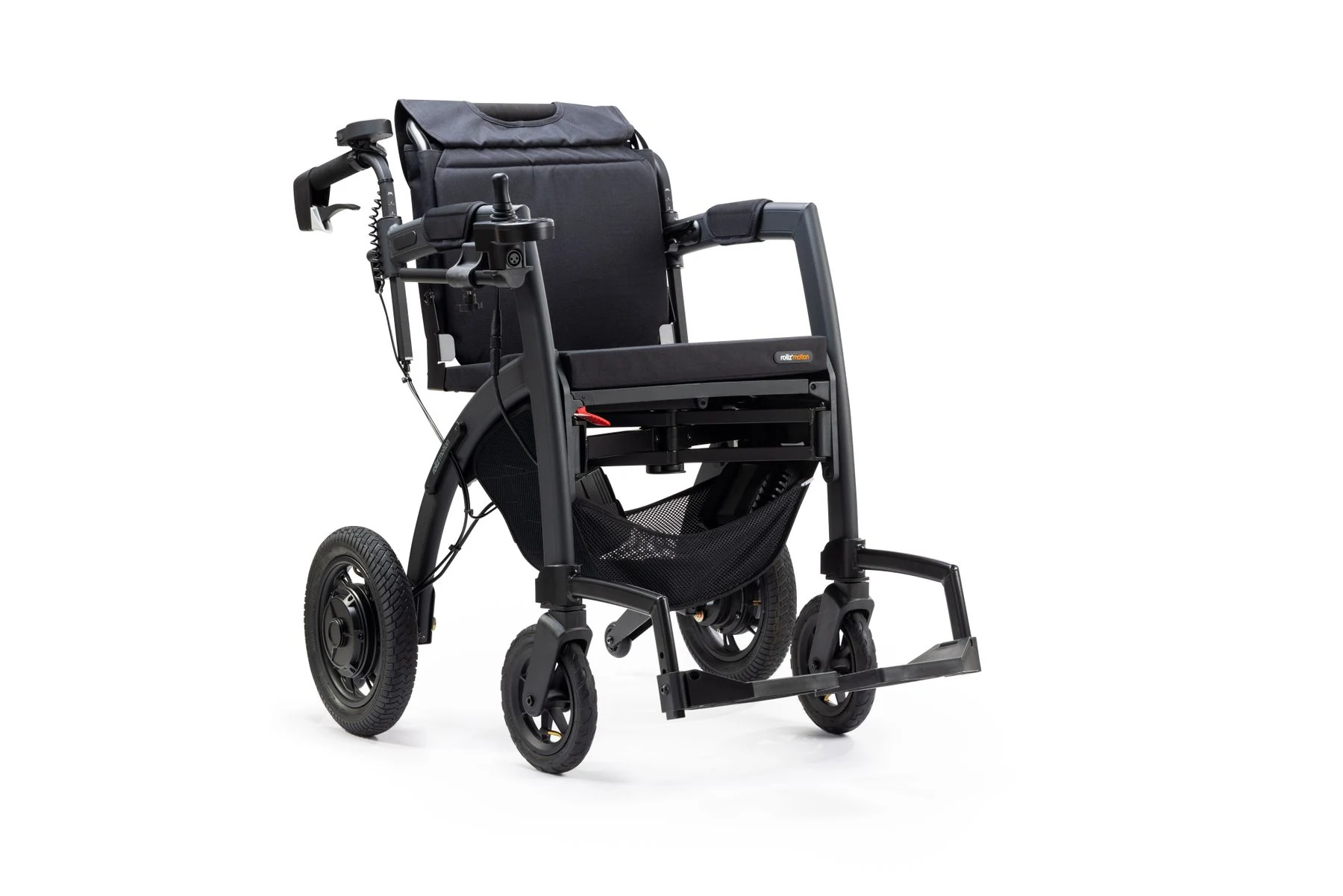
Verify the named control, its manual revision, the handover indication, and the compatibility statement for your exact chair before you commit.
Video: How to operate an Attendant Control on a @PermobilCorporation power chair - Review