

Electric wheelchair spare parts planning requires more than keeping replacement components on a shelf. Distributors need to identify the exact wheelchair models they support, confirm which parts fit each configuration, and obtain written information about availability, lead times, documentation, and after-sales responsibilities before investing in inventory.
Batteries, joysticks, controllers, motors, chargers, wheels, and other replacement parts may look similar across different electric wheelchairs, but appearance does not establish compatibility. A part that fits one model or production revision may not be suitable for another.
This guide provides 7 checks for distributors planning electric wheelchair spare parts inventory. It also distinguishes powered components from manual wheelchair and transport chair parts. The purpose is procurement and inventory verification, not technical repair, electrical installation, or individual wheelchair fitting. Confirm all model-specific requirements with the manufacturer or authorized supplier.
1. Identify the Electric Wheelchair Models You Support
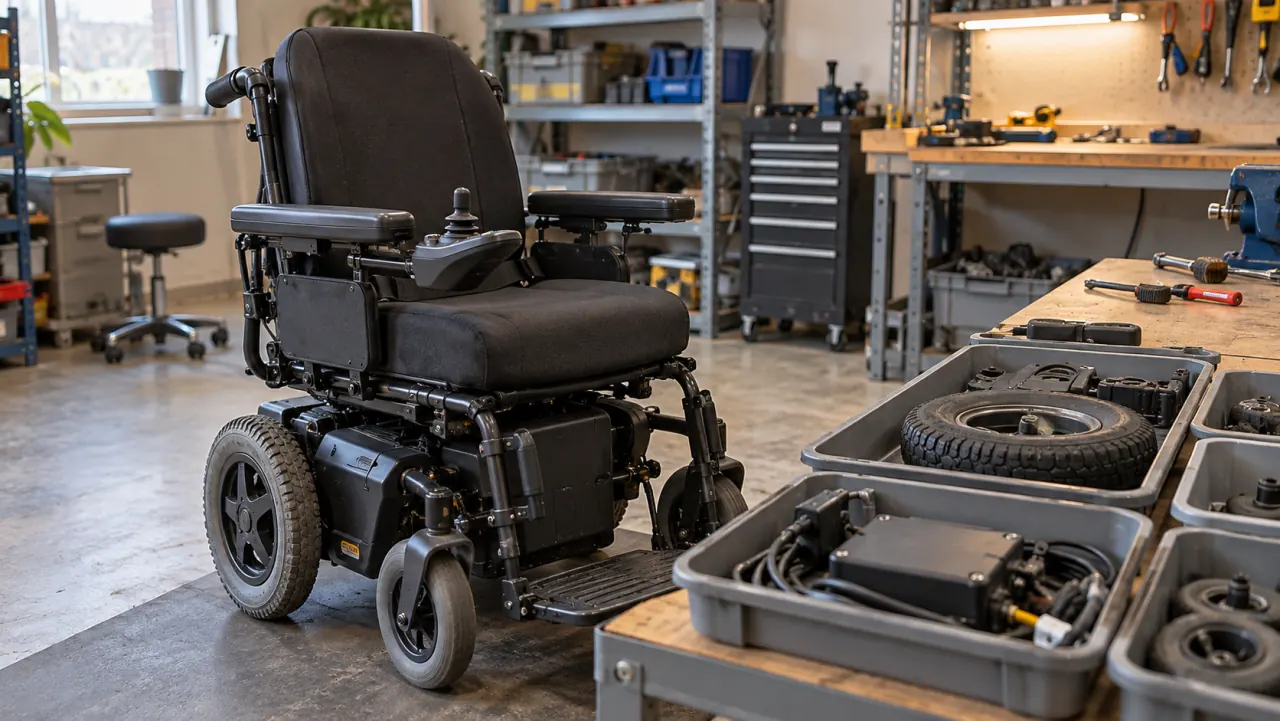
Start with the installed wheelchair population rather than a general replacement-parts shopping list. A distributor may support several models that use different electrical systems, seating arrangements, wheel assemblies, and components.
Build a model-specific baseline using information from the existing wheelchairs, equipment records, and manufacturer documentation.
- Manufacturer and model: Record the complete model name and identifier used in the manufacturer’s documentation.
- Serial number range: Identify which units or production revisions the proposed parts must support.
- Configuration: Record relevant electrical, drive, seating, and accessory configurations.
- Operating market: Identify the destination country or region and the responsible service or distribution channel.
- Document reference: Record the manufacturer parts catalogue, service manual, drawing, or compatibility statement and its revision date.
Do not assume that every wheelchair carrying the same family name uses identical spare parts. Changes between production versions may affect connectors, mounting points, electronic components, and part numbers.
For an example of model-based spare parts organization, Permobil’s spare parts guide separates current, supported, and unsupported wheelchair models. That is a manufacturer-specific example of why model status matters; it does not establish Wheelchairs Factory inventory, compatibility, or product support.
2. Separate Electric, Manual, and Transport Wheelchair Parts
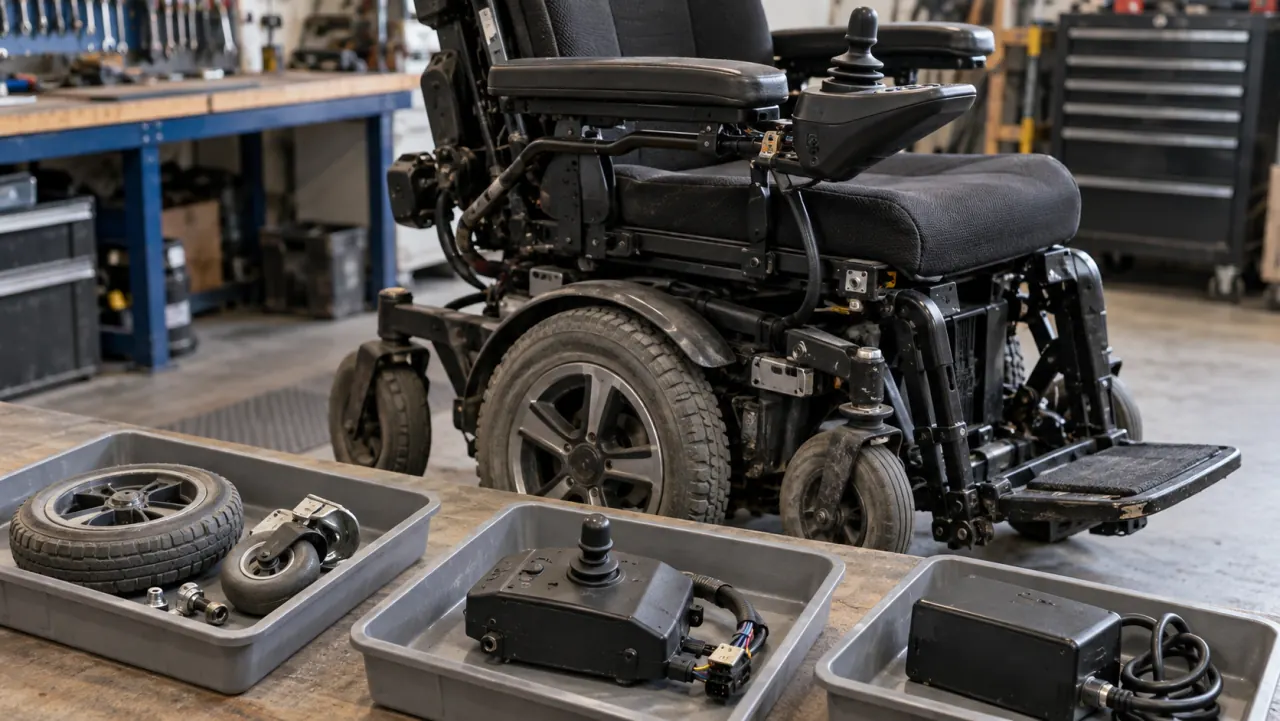
Different wheelchair categories require different spare-parts planning tracks. Some mechanical components appear across chair types, but their part numbers and compatibility requirements still need separate confirmation.
Electric Wheelchair Replacement Parts
Common electric wheelchair spare parts categories may include batteries, joysticks, electronic controllers, battery chargers, drive motors, wiring harnesses, wheel assemblies, casters, anti-tip components, and mounting hardware.
For electrical and electronic components, request confirmation of the relevant voltage, current ratings, connector or pinout, battery chemistry, charger compatibility, and software or programming requirements where applicable.
A connector that physically fits does not establish electrical compatibility. Similarly, a replacement controller or joystick may require a specific software version or manufacturer-authorized configuration.
These are categories for procurement review, not permission to substitute parts or perform electrical work. The exact wheelchair manufacturer and qualified service provider must confirm compatibility and any required installation or programming.
Manual Wheelchair Replacement Parts
Manual wheelchair spare parts planning generally focuses on mechanical components, such as rear wheels, tires, casters, handrims, wheel locks, axle hardware, upholstery, seating components, footrests, and frame-related hardware.
Check wheel dimensions, axle specifications, mounting patterns, fasteners, and the relevant model revision. Parts with the same general dimensions are not necessarily interchangeable.
Transport Chair Replacement Parts
Transport chairs are typically attendant-propelled and often have folding frames and smaller wheel arrangements. Planning categories may include wheels, caster assemblies, attendant brakes, folding mechanisms, foot supports, handles, and model-specific straps or accessories.
Verify attachment points, component purpose, and manufacturer part references. A general strap or bracket description does not establish compatibility with positioning, restraint, or transport-related functions.
3. Build a Four-Step Spare Parts Planning Process

A practical electric wheelchair spare parts planning process connects equipment records, candidate part numbers, inventory priorities, and written supplier verification.
- Identify the installed population. Group the wheelchairs by manufacturer, model, serial range, production revision, and destination market. Keep different configurations separate.
- Create a candidate parts list. Use existing service documentation, part labels, manufacturer diagrams, and repair-history records to identify potential spare parts. Mark unconfirmed items as candidates rather than approved replacements.
- Review inventory priorities. Examine the installed quantity, previous demand, service impact, supplier lead time, and available support arrangements. The responsible technical team should identify which parts affect safe operation or service availability.
- Verify before ordering. Request written confirmation of exact part numbers, model compatibility, revision applicability, minimum order quantities, lead times, transport restrictions, and warranty or return conditions.
What to Record in a Spare Parts Inventory Register
Maintain a separate record for each proposed spare part. The register should make clear whether compatibility and supply information have been verified.
| Planning field | Information to record | Verification purpose |
|---|---|---|
| Wheelchair model | Manufacturer, model, configuration, and applicable serial range. | Connects the part to the installed equipment population. |
| Spare part identity | Manufacturer part number, description, and revision where available. | Prevents substitutions based only on appearance or generic names. |
| Compatibility evidence | Current parts catalogue, manufacturer drawing, or written supplier confirmation. | Shows which models and revisions are supported by the claim. |
| Installed population and demand | Number of applicable chairs, historical parts usage, and available service records. | Provides inputs for locally determined inventory priorities. |
| Inventory status | Current stock, reserved quantity, incoming orders, and stock location. | Helps distinguish available inventory from future supply. |
| Supplier terms | Quoted lead time, minimum order quantity, price reference, and quotation date. | Supports purchasing decisions using current written information. |
| Support and restrictions | Warranty, return conditions, storage, transport, and required documentation. | Identifies additional conditions before procurement. |
| Review status | Verified, clarification required, or not applicable, with reviewer and date. | Keeps unresolved compatibility and supply questions visible. |
The register is a planning template, not a universal stock-level recommendation. Safety-stock quantities and reorder points should be established using the distributor’s actual demand, support obligations, lead-time variability, storage conditions, and approved inventory policy.
A component with a long supplier lead time may need a different purchasing approach from a frequently available wear item. However, do not classify a part as critical or approve a substitute without the appropriate technical review.
4. Ask Suppliers These Questions Before Stock Commitment

Before investing in electric wheelchair spare parts inventory, request model-specific answers from the manufacturer or authorized supplier. Keep the written response connected to the exact proposed part and quotation.
Compatibility and Technical Questions
- Which wheelchair models, configurations, and serial number ranges does the part support?
- What is the exact manufacturer part number and applicable revision?
- Is the item an original equipment manufacturer (OEM) part, a manufacturer-approved alternative, or an aftermarket component?
- Does the manufacturer provide a model compatibility matrix or parts catalogue reference?
- For electrical components, which voltage, current, connector, software, and programming conditions apply?
- For batteries and chargers, which battery chemistry, charging specifications, and manufacturer-approved pairings apply?
Commercial and Supply Questions
- What is the current available stock or production status for the exact part number?
- What minimum order quantity, order multiple, or batch requirements apply?
- When does the quoted lead time begin, and how long is the quotation valid?
- What happens when a part is discontinued, replaced, or superseded by a new revision?
- Which warranty, defective-part return, and incorrect-shipment procedures apply?
- What storage, shipping, documentation, or destination-market requirements must be confirmed?
Request written answers rather than relying on generic product descriptions. A supplier may be able to quote a similar component without confirming that it is an approved replacement for the installed wheelchair.
5. Compare Spare Parts Planning by Wheelchair Type

Electric, manual, and transport wheelchairs share some component categories, but their inventory risks and verification requirements are not identical. Use the comparison below to organize planning responsibilities.
| Planning factor | Electric wheelchair | Manual wheelchair | Transport chair |
|---|---|---|---|
| Main compatibility concern | Electrical, electronic, software, and mechanical compatibility. | Mechanical fit, wheel assemblies, axles, and braking components. | Folding mechanisms, small wheels, brakes, and attachment hardware. |
| Typical spare parts categories | Batteries, chargers, controllers, joysticks, motors, wiring, wheels, and casters. | Rear wheels, tires, casters, handrims, wheel locks, axle hardware, and upholstery. | Wheels, casters, brakes, folding components, footrests, and specified accessories. |
| Documents to prioritize | Model parts list, electrical compatibility references, and applicable service documentation. | Parts diagrams, mechanical specifications, and mounting references. | Parts diagrams, component dimensions, and attachment information. |
| Common assumption to avoid | A matching plug means a controller, charger, or battery is compatible. | Components with the same nominal wheel size are interchangeable. | A similar strap or bracket has the same intended function. |
Keep separate model records even when similar parts are used across categories. A distributor may choose to consolidate inventory only after the manufacturer or authorized supplier confirms that the relevant parts can be used for each listed model and configuration.
6. Verify Incoming Spare Parts Information Before Acceptance

Receiving a replacement component is not the same as confirming that it is correct for the intended wheelchair. The incoming-parts review should compare the shipment against the approved purchase order and verified parts information.
Use the following checklist when reviewing supplier documents and receiving records:
- Product identity: Confirm the supplier, manufacturer part number, description, and revision against the order.
- Compatibility: Match the stated wheelchair model and serial range to the documented approval.
- Electrical information: Check the supplied specifications against the approved documentation for voltage, current, connector, pinout, and relevant software requirements.
- Mechanical information: Compare required dimensions, mounting references, wheel or axle specifications, and other applicable details.
- Shipping and storage: Review relevant restrictions, packaging condition, labels, and handling documents.
- Supplier documentation: Confirm that the shipment includes the documents agreed in the purchase order.
- Exceptions: Record incorrect, damaged, unidentified, or substituted items and assign the issue to the appropriate reviewer.
Do not install or distribute an unconfirmed replacement part simply because it resembles the original component. Keep technical inspection and installation decisions with the manufacturer-authorized or otherwise qualified service team.
Additional Checks for Batteries and Electrical Components
Batteries require additional attention because their chemistry, condition, configuration, and transport route can affect handling requirements. Confirm the current battery and charger specifications before ordering or arranging shipment.
For U.S. lithium-battery shipments, the U.S. Department of Transportation’s lithium battery guidance provides transport requirements and information about damaged or defective batteries. Apply the requirements relevant to the actual shipment and destination; do not assume a general parcel service accepts every battery or condition.
For end-of-life batteries, the U.S. Environmental Protection Agency’s lithium-ion battery guidance explains why used batteries need separate recycling or collection arrangements. Recycling rules for used batteries should not be confused with procurement and transport approval for new replacement batteries.
Keep missing battery identification, shipping documentation, or damage-related questions open until the responsible supplier, qualified handler, or applicable authority confirms the required process.
7. Prepare a Model-Specific Spare Parts Supplier Enquiry

When contacting a wheelchair manufacturer or authorized parts supplier, provide enough information to identify the equipment population and the exact components under consideration.
A useful distributor enquiry should include:
- The wheelchair manufacturer, model list, and relevant serial number ranges.
- Existing part numbers or manufacturer diagram references, if available.
- The required replacement components and estimated annual demand.
- The destination country and distribution or service market.
- Any known electrical configuration, battery, controller, or mechanical compatibility questions.
- Requested documentation, quotation terms, delivery information, and after-sales requirements.
Ask the supplier to distinguish confirmed compatible parts from proposed alternatives, unavailable items, and questions requiring additional model information.
For a Wheelchairs Factory sourcing enquiry, identify the relevant wheelchair model and required parts before requesting model-specific documentation. This guide does not establish that any particular replacement component, quantity, lead time, warranty, or technical service is currently offered.
Final Electric Wheelchair Spare Parts Planning Checklist
Before committing inventory funds or approving a replacement-parts order, confirm the following:
- Each spare part is linked to the exact wheelchair model, configuration, and applicable serial range.
- The manufacturer part number and any revision information are recorded.
- Electrical and mechanical compatibility claims have supporting manufacturer or authorized supplier documentation.
- Electric, manual, and transport wheelchair planning records remain distinguishable.
- Inventory priorities are based on the installed equipment population, documented demand, supplier lead times, and approved service requirements.
- Minimum order quantities, current quotations, stock information, and delivery conditions have been confirmed in writing.
- Storage, transport, warranty, return, and destination documentation requirements are assigned to responsible reviewers.
- Unresolved compatibility or supply questions remain open rather than being treated as approved.
Effective electric wheelchair spare parts planning begins with verified model information and ends with a traceable purchasing decision. By keeping compatibility, supply evidence, inventory priorities, and supplier responsibilities together, distributors can make better-informed stock commitments without assuming that similar-looking parts are interchangeable.
Video: Power Wheelchair Serial Numbers for Replacement Parts — Mobility Scooters Direct (third-party examples)